Wednesday, June 25, 2008

Flomerics/Autodesk - No Deal!!

There has been a bunch of speculation on the future of Flomerics. More news has been released this morning that it looks like the deal with Autodesk is not going to happen. Not surprised really as I said in previous posts, just doesn't seem to make any sense for both Autodesk and Flomerics.

It does look, however, like Mentor Graphics is still in the running. This makes a bit more sense to me considering Flomerics has had such a history in the electronics industry. But Mentor is also in discussions with Cadence for a merger/acquisition. Big decisions to be made, for sure. Definitely fun to watch, especially as a spectator and not one of the guys that has to sign the deal.

Seems like everyone is scarmbling to find a new home recently. Acquisitions seem to be happening weekly in the CAE industry. Certainly seems to be the trend to have a few big boys swallowing up everyone and have a monopoloy on the market.

Sounds familiar. Pretty sure we have seen this before.

Tuesday, June 24, 2008

The “Ribbon Bar” is hitting the CAE Industry by Storm

I have enjoyed a week away with the family and had a chance to do some surfing around to see catch up on the latest and greatest. I was talking to a buddy the other day and the topic of whether we liked the new ribbon bars that were rolled out with the new Office 2007 products. Whether fortunate or unfortunate, I was late in having access to the Office 2007 suite of products. My first introduction to the ribbon bars was with Spaceclaim 2007. It was only after a few months of driving Spaceclaim that I really appreciated that they simply adopted the latest thing coming out of Microsoft. Like them or hate them (Microsoft that is), I think they hit a homerun with the ribbons interface.

Like everyone, I was a bit frustrated when I tried to create my first spreadsheet and power point presentation. I still find myself "looking" for things, but in general, I am getting it. But more importantly, as products (SolidWorks 2008, SnagIt9, Spaceclaim, now Inventor and Solid Edge ST) are all rolling out their flavor of the ribbons interface, I am really enjoying it. I know there are the elitists out there that hate when all programs look and act alike. However, I have to admit, I find it refreshing that the framework is relatively the same and allow each individual vendor to maximize the potential.


Surfing around, I stumbled across Inventor's "preview" of the Ribbon UI on their Labs site. Above is a quick demo. I am becoming a huge fan of the ribbons interface. I think it is the next big thing for the CAE industry. Pretty exciting to see what the vendors will do with the basic infrastructure.

Wednesday, June 11, 2008

SnagIt! 9: Nice!!!

Techsmith continues to amaze. Each time a new release of Snag It comes out, they include a bucket of new features that really increase productivity of the tool. The new interface takes on the look and feel of ribbons, a spin-off of the Office 2007 interface.


When the "ribbons" UI was released, I really struggled to get my first few spreadsheets and presentations together. But the more I use it, I love it. Especially the more companies that adopt and tweak the platform, the easier everything will become. In my world, SolidWorks, Spaceclaim and now SnagIt have all jumped on the train. I just saw a sneak peak at the new Solid Edge with Synchronous Technology and they have jumped on as well. I am a big fan of creative new fresh interfaces, but I am also a huge fan of completely intuitive interfaces that respond exactly the way we as users, expect them to respond.

There is a cool video that highlights all of the new features in detail.

But if you are not already a SnagIt user, just download it for 30days - I am convinced you'll be hooked.

Tuesday, June 10, 2008

Flomerics/Autodesk Merger???

Always interesting to see when news of a merger is "leaked" to the press.

Not sure how much merit to give this news or if it is similar hype to Yahoo/Microsoft debacle? Obviously, not on the same scale.

But in my world, it is actually much bigger news. Always trying to look at things from every angle, I am trying to figure this one out.

So, Autodesk's claim is to be the father of Digital Prototyping. With their acquisition of Alias on the design side and then Plassotech on the analysis side, I can see a common theme. They seem to be building momentum. So far so good.

Then there was the recent announcement that they were purchasing Moldflow??! A bit of a stretch as Moldflow is a pretty sophisticated analyst type tool. But, I have always felt that if done properly, Moldflow could be put in the hands of the design community. Always a difficult task when you have a "big boy" product that is priced fairly high, the tendency is to develop an "Express" tool to tease the user base. Exactly what has happened there.

So at least it appears as though Autodesk is not only jumping into the analysis business, but they are trying to make a big leap. Pretty tall task. They are trying to convert some of their AutoCAD customers to Inventor, but they are now exposing them to some specialist type of analysis tool. AND, they sell majority of their products through a reseller network. What SolidWorks did with COSMOS seemed unheard of at the time, but they seemed to do a great job. But, what COSMOS does and what Moldflow/Flomerics do are drastically different. Not sure it would be possible to push these products through a channel?

Continuing with that theme, we now see that Autodesk is entertaining the idea of acquiring Flomerics. Trying to be open minded here, but I am searching for the logic. Ok, so historically, Flomerics has had tools (Flotherm, Flovent etc) that were geared almost strictly for the analyst-only community. They acquired NIKA to give themselves some exposure to the design community. NIKA has modules that are geared toward Pro/e, SolidWorks and Catia V5 users. They also have a general module for everyone else. The general module uses SolidWorks on the front-end...! Hmmm.. So, where does the Flomerics "solution" fit in with Autodesk's grand scheme. I am obviously not privy to the logic, but seems like a cluster to me.

Anyway, all this merger stuff is great fun to watch.

Sunday, June 08, 2008

Autodesk France does it in style

I was fortunate enough to participate in an event hosted by the largest Autodesk reseller in France. They conducted the event at Chateau Rajat. That is Rajat Castle to us Yanks. Simply amazing. Typical event, there were break out sessions in various rooms showing all the cool latest goods rolling out of Autodesk - Revit, Inventor, Autocad etc.


We were given the opportunity to present CFdesign for Inventor to a small group. Below is a quick link to a lightening quick demo of an exhaust manifold flow analysis in Inventor 2009.


After the event, a colleague and I sat in one of the grand ballrooms working on a few projects. It was really cool to be sitting in a castle that was a few 100 years old (new in French terms) connected wirelessly to the outside world. Clearly one of the small perks of being a road warrior.


Thursday, June 05, 2008

A New Found Respect for GPS Systems

I have spent the last few days navigating my way through France. Normally, I am fortunate enough to be riding shotgun while one of the local guys does the driving. Not this time. I have driven from Switzerland through quite a few towns in France all with no map whatsoever. I got the tip from a colleague to rent a GPS with the rental car. Enter the TomTom.

I used to think that GPS devices were just another gadget that the hi-tech geeks were carrying around. But I have to admit, I would have been literally lost all week without it. It is super simple to use and has worked so far seemlessly.

I have travled by car from the middle of nowhere in France to the other side of nowhere in France and many cool places in between. The TomTom is super easy to use and has a 1000 extra features that I almost crashed a few times trying to check out a few times on the fly.

It is amazing how simple it is to use and how accurate it was even in little towns/villages in France. It helped me out quite a bit on round-abouts. Those things kill me everytime. I feel like Chevy Chase in European Vacation just doing loops until I just pick an exit.


Couln't help notice how hot these things get. I had it plugged in majority of the time in the car, but when I would stop for a bite I would take it with me. Quite a bit of heat being generated in these things. Above is a model I did quite a while ago for a "fish finder" company. Same general idea, about 5x bigger in size than today's GPS gadgets, but relatively same deal.

Goal is to make these things rugged as hell, air/water tight, cool looking and extremely dependable. No small feat for a designer. Apparently, I need to get on it as everyone in Europe seems to have one of these guys. Might need to jump on the bandwagon as I am sold.

Wednesday, June 04, 2008

Google Docs: My Future Office Tool?

I have been using Google Docs quite a bit lately. Everything from Documents, Spreadsheets to Presentations. They are Google's answer to web-based Office tools. Another check mark for On-Demand software tools for me to check out. As expected, Google Docs are pretty simple and straight forward. They have a good-majority of the tools that are in MS Office, but are definitely missing some of the bells and whistles.

When MS released Office 2007, my emotions have gone from excitement about the new interface, to frustration when looking for certain everyday features, back to excitement. I really like the interface. I use Power Point quite a bit and really like the insert image, text boxes etc features. It definitely has a "next generation" look and feel about it. Makes total sense that SpaceClaim modeled their interface almost exactly the same. The same can be said for SolidWorks, definitely has an Office 2007 vibe to it. So, if I like Office 2007 so much, why jump over to the dark side and check out Google? Well, simply put, I was curious. But the biggest niche that Google docs fills for me is the online collaboration.

Each document can have one or more "collaborators". So, a team can access and update a living breathing document all at the same time. I can even see when a member of my team is currently working on the document. This is huge for me. I travel quite a bit and work remotely when I am in the office. So, having this collaboration ability is huge. Their are many other positives to list about Google Docs as well. For example, they have the ability to work offline and sync as needed once connected. They seem to work well with MS files both ways (they open and save out). Plus check out below you can link You Tube Videos to them.

Pretty amusing that the biggest limitation of Google Docs is exactly what I do not like about MS Office. That is that Google still lacks some of the advanced features that I use in Office. I am clearly not a power user of the Office Products, but like everyone, there are certain features that I have found that I rely on and use all the time. Google will get there with time as they seem to be constantly updating.

Plus, did I mention Google Docs is free? Anyway, check them out.

Monday, June 02, 2008

Wow, Dassault Systemes Announces V6 & PLM 2.0

I look forward to the daily CAD industry emails that I receive everyday. MCAD Cafe and Tenlinks are my favorites. I usually look at them for about 10 seconds scanning for something to pop out at me. Not exactly sure what I am looking for but mostly related to the new releases of CAD, CFD related things and the next big thing. Check out the link on V6 coming out of Dassault.


Being a bit obsessed with web based on-demand software lately. This idea of PLM 2.0 is really interesting to me. I have seen alot of companies advertise these "web tools" or their "collaboration environment" but from what I have seen, they are not being used as mush as they could and should be. Almost every company in the world, small and large, has another "foreign" site that they deal with. Whether it is another site within the same company, a supplier, potential client - we all are dealing and struggling with the idea of communicating our ideas, designs, models with other locations.

I have only seen the video coming out of DS so far, but I am anxious to see what this PLM 2.0 movement is all about.

Saturday, May 31, 2008

A Tool I Couldn't Live Without: SnagIt!

Pretty strong statement. Probably a bit extreme, but I think you get where I am coming from. There are those software tools out there that we use everyday, whether we like to or not. Some we use because they just get the job done. Others we use because they make a certain aspect of our jobs easier. Then there are others that we simply like to use.

Quite frankly, I think SnagIt falls into all of those categories for me. Simply put, SnagIt is a screen capture software product by Techsmith. SnagIt has been around for along time and many of the people reading this have either used it or heard of it. It is super handy to create static images, avi's, add text or other features to images etc. Plus it comes with its own little editor, which is shown above.

But I think what I like the most about it is the whole package.

  1. Tool that everyone can use
  2. Super easy to use - does what I expect
  3. Has non-intrusive plug-ins to almost everything
  4. Has simple hot keys like "Print Screen"
  5. It's cheap - $39.95
  6. It allows for a classic no hassle 30-day eval

So anyone out there can simply go to their website, try it for 30days and if yo like it, you pay the ~$40.. Pretty simple. Plus I just got a notice the other day to upgrade to the latest version for free. Techsmith is a cool little company. It has alot of really great products. They certainly fill a niche out there and as far as I know, they are the only ones in the game?

What other products do you use everyday??

Sunday, May 25, 2008

Need a Link; Give a Link: Call for Engineering Links

Ever go into a store and see a cup with a note, "Need a Penny; Give a Penny"? Same applies here. Over 100+ unique readers check in each week, so if we can each leave one or two of our favorite links, we can grow quite a list.


All you have to do is leave a quick comment with the link and a quick statement (if applicable) of what you use it for. I'll start the list. Obviously, the standard is Matweb - clearly the most popular among the bunch. All of you flow guys out there, really looking for good fluid flow property sites.

Unit Conversion Calculator

Another Unit Converter

General Material Properties - Matweb

Plastic Material Properties

Pipe Pressure Loss Calculator

Compressible Flow Refresher

Atmospheric Pressure Calculator

Old School Mesh Size Calculator

eFluids - random fluid links

CFD Lecture Notes

Electronics Cooling Magazine

CFD-online - great CFD discussion forums

I will begin to organize these a bit more as comments are posted. Disclaimer- these are all links that I have used over the years. Take them for what they are - random links.

Friday, May 23, 2008

LED's are more than just another type of lightbulb..!

I have been talking to a fair number of engineers in lighting companies that are currently working on implementing "LEDs" into their product designs. Definitely the new thing right now. Let's look at why...

  1. They are more energy efficient (more lumens/Watt).
  2. The lighting is directional, so there is no wasted light.
  3. Very long lifetime- 50-100k hours.
  4. Environmentally sound - no Hg, Pb etc.
  5. Infinitely dimmable
  6. Work great in cold environments


Above is a video of a model we did for a customer recently. The user wanted to optimize the performance by ensuring that the junction temperature stayed below a critical value. We tried a variety of options, such as, different heat sink designs, different LED arrangements and different housing configurations. Classic application for Upfront CFD. Allows us to provide an answer to the classic question, "what if?".

There are a variety of challenges for engineers that are new to the LED world. Here is a list of the challenges engineers are facing.

  1. The desire to get the maximum output, so engineers are constantly pushing the limit of the LED devices.
  2. There is not enough data available so the "rules of thumb" are currently being developed.
  3. The data provided to engineers is not accurate from the manufacturers.
  4. The testing that is being done does not replicate the actual environments in which the LEDs are being used.
  5. A wide variance in the lifespan of the LEDs based on the junction temperatures.
  6. Finding creative ways to manage the heat.

The overwhelming concern for engineers is to maintain the junction temperature. Check out the graph above. It shows how increasing the junction temperautre drastically reduces the lifescycle of the LED.

There is a ton of info out there on the web that goes into more specifics. Go check it out. Always fun to be able to help engineers solve some of their fundamental issues. To me, LEDs are not much different than any other product out there from a simulation perspective. But it has been interesting learning more and more about how they are being used in the world.

Saturday, May 17, 2008

iskoot: skype for mobile phones

I received an email from a good friend, telling me to check out iskoot. It is a 3rd party application that allows you to access skype on your mobile.

It allows for texting, calling etc all through Skype. You are able to see if your contacts are online (check out the view below). If you call a Skype user, it is free. If you call a landline or mobile number, it charges your Skype Credit. Obviously, if you have a monthly plan, than the fees will be covered. I have recently switched to the Unlimited World Plan. It allowed me save over a $110/mo. on my office phone. I actually cancelled my office landline. I can use call forwarding, voice mail when on the road.


I just recently tested this out for a week in Europe. Works great. The only requirement is to have a data plan. It's not clear whether or not my mobile carrier will charge an additional SMS fee? So I only used it sparingly.

But, if I do not incur any additional fees, this will change the way I can communicate when traveling abroad. Currently text messages can cost up to $0.50/text. So if this works out, I will be able to save a fortune staying in contact with members of our team.

So, where's the catch? Not exactly sure?! I suspect there are more hidden costs than advertised. We'll see at the end of the month. Also, where does iskoot make their $$$? I recently read an interview with their CEO, who implied that there will be a small monthly fee once a network of users has been established.

Skype recently announced a Skype for Mobile package. I tried downloading it, but failed every time. Currently it is in BETA, so I will let you know how things progress. Even if there is a fee, Skype has certainly changed the way that I stay connected. The best thing is that it is at a fraction of the cost of the traditional methods.

Wednesday, May 07, 2008

On-demand "remote" Upfront Simulation?!?

There has always been buzz in the CAE industry for users to take advantage of remote cluster computing. Essentially, you would set up your models locally on a machine and run it on a server hosted by a vendor. Some of the old timers, like Fluent, have been in this business for a number of years. I tried their version about 5 years ago. Cool in concept, but the interface and process took some getting used to. I found it difficult to track the model's progress.

The main problem or limitation on this capability will be the bandwidth. As internet access becomes more readily available and connections speeds improve, I think there is a future in "cloud computing" for Upfront CAE.

I currently do a mocked up version of cloud computing myself. I have a laptop and 64-bit desktop. In CFdesign, I am able to choose which machine I want to solve on directly from within the interface. So, this allows me to very efficiently setup and review models on my laptop and solve and store them on my desktop. I can even do this similar process remote. Takes a bit more copying and pasting and uploading/downloading but it works for now. Still trying to get Remote Desktop to work reliably. In the meantime, I will stick with GOTOMYPC. I used this all week while in Amserdam. Even on a fairly slow connection, I was able to access my dekstop and review a model's progress.

Ideally, I would love to improve this process. Here's my wish list. For starters, I would like to build models on my laptop, set them up etc and hit "GO" and have the option of what computer to solve on, even when I am traveling. I would like to have a "favorites" list of computers to choose. Some of us have one or two machines to use, others have a bit more. The file exchange would have to be super fast and lightweight. I then want a "link" to be created that I can access from any browser where I can monitor performance - convergence, mesh quality, mass balance, max temps, max pressures... I want the interface to have the look and feel of a modern web page that I can access from any computer or my phone!. To make life easier, I would like to have the option to have a text message or email sent with the link so I can have immediate access to it. I also want the option to text/email me when the model is finished, encountered an error or simply update me on the progress.

Version 2.0 should have a lightweight preview of the model (similar to JT or Adobe 3d) that allows me to pan, zoom, rotate and view my results. If I could have acces to all of the results, that would be great. But a lightweight model seems to make the most sense for web browsing.

This whole process would be great if I could do this on my "other" machine. But what if I had the option to do this to a remote farm of computers hosted by the software vendor? This way, I could have access to unlimited computing power, unlimited storage capacity (with a fee of course) and unlimited access to technical support in the event that something went wrong. A premium support model would exist so that I can "collaborate" with a support engineer using a variety of medias (texting, iming, email, forum type posts).

Think of the info that could be provided to the vendor on performance, mesh times and sizes, solver times, solver performance, application statistics etc.. The pluses are endless for all.

If I could add version 3.0 to my wish list - it would include driving optimization via this web interface. Cloud computing will only be appropriate for a select group of engineers. But I think the concept can give us endless possibilities. I am looking forward to seeing where the on-demand market takes the CAE industry.

Sunday, May 04, 2008

On-Demand Applications in the CAE Industry - Part I

I think "on-demand" software has its place in the future in the CAE industry. Not sure if "on-demand" is the correct way to categorize it all, but I think it explains it fairly well. I am referring to applications that reside on a remote server and are accessed via the web, rather than run locally from the desktop.


It already exists in certain aspects. It was about 10 years ago that I came across "bom.com". It was a company that positioned handling all of the data management, bill of materials etc via the web. At the time, I thought it was a very cool idea, but they were the days when we were paying for AOL by the minute. As cool as I thought the concept was, I thought the name of their company was even cooler. I never imagined that the web would evolve into what it is today. Obviously the guys at bom.com did, as they have evolved into Arena Solutions. I snagged the above image off their site. They can explain what they do way better than I, go check them out.

Today, all of the CAD companies each have their own flavor of on-demand PDM and project management tools. I recently used Autodesk Streamline while working with a client in California. We used it to share files for a project. Sure beats the security nightmares of ftp sites.

I have recently become completely obsessed with on-demand solutions. I am using Google docs daily. I find its a great way to keep my files in order, available wherever I am, plus it allows me to share the files with members of our team. There are numerous other on-demand applications that I am looking into. Stay tuned, a bunch more to come on this topic.

Sunday, April 27, 2008

Will Amazon enter the CAE industry?

I really enjoy listening to Jeff Bezos, founder of Amazon. He thinks out of the box and it has been proven time and again that he knows how to make things happen. I have to admit that I only understand a small portion of what he is saying regarding the scalability of Amazon etc.

But I stumbled on an article in this month's Wired magazine on Amazon Web Services (AWS). There was a reference to "cloud computing". Essentially it allows start-ups, developers etc. to develop the next best thing while utilizing the massive computation and hardware resources of Amazon. They have dumped close to $2B into the IT infrastructure. Yeah, B=billion!!!

So, this seems like a variation of ASP's (Application Service Providers) or something that could rival Google Apps. This idea has been around for quite some time, but until recently broadband accessibility was in its infancy. This is changing rapidly. It will not be in the distant future that we will be connected all the time, everywhere we go.

Web based computing for engineers is not too far behind. Some companies already offer this service for a small select % of their users. However, the process is too clunky, model sizes are too large and the amount of user interaction is too high. I firmly believe that this will evolve in the near future, drastically. It is already happening on the PDM/PLM side of the world. Take Arena Solutions, for example. They coin their technology, "on demand".

I am looking forward to the day when Upfront CFD is available as an online app. The computing can be done "in the clouds". Allows for really large models to run really fast. Would be kind of odd to do your engineering design via Amazon? But, I think it will only be a matter of time before one of the big boys gets involved in CAE. Whether it be Amazon, Microsoft, Apple - whoever. Personally, I hope to never have to deal with these monster companies. But, I would love to leverage some of their technology to make our lives a bit easier.

Tuesday, April 22, 2008

Everyday is Earth Day

Today is Earth Day. It has been an annual event to promote awareness and appreciation of the Earth's environment. I remember attending a festival ~15 years ago and it mainly consisted of hippy environmentalists. Today it is becoming a part of everyone's responsibility to do their part.

We as consumers are encouraged to be conscious of the energy we consume, the trash we create and the products we buy. It is amazing how easy it can be if we just take a minute to think about it. We can all adjust the thermostat, recycle what we can and turn out lights that are not being used. This is just the tip of the iceberg.

We as engineers have a responsbility to do what we can to help expand the technology to make the world a bit greener. We in the simulation world are seeing a surge in optimizing products to help the cause.

I am looking forward to doing my part. I am also looking forward to seeing the technology that evolves in an effort to help improve the environment.

Monday, April 21, 2008

CFdesign is the Preferred Industry Partner for Autodesk

This post is more than just a marketing plug. I've been running Inventor since it came onto the market. It sure started off slow. It lagged substantially behind SolidWorks and Solid Edge. But over the last few releases it has advanced quite a bit.


I was fortunate enough to participate in an Autodesk event a few weeks ago. I saw first hand the vision of Autodesk the company and the plans for Inventor. It was awesome to see how Alias, Autocad, ProductStream etc all worked seamlessly together. I am really looking forward to the world of Simulation for Autodesk, I think they have a bright future in an untapped market for their customers.

Tuesday, April 15, 2008

Offshore Technology Conference (OTC) is around the corner

We have had quite a bit of success helping folks in the Oil & Gas Industry design better products. It is interesting that 95% of what they do involves fluid flow and some thermal, yet doing CFD early in the design phase is relatively new to them. Quite similar story in many industries, actually. But this all changing for the better. Check out the video below (has audio too...).


We will be at OTC this year. For some this may be near and dear to you, others - probably not. OTC is the world’s foremost event for the development of offshore resources in the fields of drilling, exploration, production and environmental protection. With more than 2,500 exhibiting companies, divisions, and subsidiaries, the Offshore Technology Conference (OTC) is the largest conference and exhibition in the offshore industry. It is being held at the Reliant Center in Houston, TX on May 5-8th, 2008. We are sharing booth #5763 with our friends at Autodesk.

Sunday, April 13, 2008

Remoting into your Remote Office???

It is often the case that you need to gain access to your "other" computer. Whether you are in a colleague's office, at home or traveling. If you are on the network, you can always use Remote Desktop in Windows. Seems to work ok, but definitely has its issues.

Since I work remote, I have a small little network that I can use Remote Desktop to view my desktop from my laptop. Works fairly well when I am downstairs and do not feel like running upstairs to check on a model. But what happens when I am on the road? I cannot seem to use Remote Desktop. The documentation claims that there is a "web" option, but I can never seem to get it to work.


Enter GoToMyPC. It is a web based system that you can connect to any computer as long as you have an Internet connection. It works really well. While in Europe, I have been able to successfully connect to my desktop back in the US, even with a slow connection. I can run applications as well as copy files back and forth with only a small delay.

I am interested to hear if people have had similar experience with Remote Desktop in Windows?

Saturday, April 12, 2008

Marin Bikes are designed using Autodesk Products

I wrote in a previous post, that I have been bicycle shopping. I chose to stick with REI as my bike shop. Quite a few reasons why I chose REI, partly because it is local to my house and I figured I'd support the co-op. The two main bike brands that REI sells are Novara and Marin. It was tough to decide between the two, but I noticed the Marin had a sticker "designed using Autodesk". Being a big fan and user of Autodesk Inventor, I easily picked the Marin.

I decided to go with the Marin Muirwoods 29er. It is a hybrid bike that I can ride mostly on the streets of Philly but allows me to hit some of the gravel paths in the neighborhood parks.


Here is another shot of a model our team worked on for one of the other bike manufacturers.


I am looking forward to the warmer season and one of my goals this summer is to drastically reduce the need to drive a car. Not only is it great exercise, but it is one of the many things I think we all should be doing to help improve the environment.

Upfront CFD for Consumer Products: A Wake-Up Call

The more I do an unofficial market analysis, the more I think the potential for Upfront CFD is endless. There are all of the obvious applications for fluid flow and thermal simulation, but I find that often engineers do not even realize that they are having issues.

I was at an event a few years ago manning our booth. People were stopping by to see what all of the buzz was about. I gave him my 30 second pitch to what we do. I then said, "so do you have any flow or thermal issues?" He gave me the standard shrug and said, "no, not really. I don't see any application for us." Forever being stubborn, I said, "what does your company make?". "Vacuum cleaners!", he responded proudly. It was a defining moment for me. It is not in his mind-set to identify with "flow & thermal issues". It is my job to ask, "what are your design challenges?" Once I asked this question, the flood gates opened and they are now a great customer.


I tell people that the applications for Upfront CFD are endless. I woke up this morning and within a few minutes, I identified 15 applications. My mobile phone alarm buzzed early this am. As I rolled out of bed, I heard the roar of a public transportation bus (valves, hvac, hoses, radiators, electronics, hydraulics) outside my window. I walked into the bathroom, turned on the faucet, looked in the mirror and saw the washer and dryer in the corner, debated about a shower and went downstairs. I clicked on my XM radio player, walked into the kitchen for some coffee and noticed the refrigerator, coffee pot, blender, oven, microwave etc. Strapped on my shoes and ipod to walk the dogs as I heard the heater kick on. Oh yeah, I forgot to check my email on the laptop. Point is begin to think about devices and products and and ask yourself is there a fluid flowing in or around it or does it need to heat up or cool down? If so, you can probably optimize the design using Upfront CFD.

The above images are only a small percentage of the 1000s of applications out there in the world. CFD has been around for along time, but has really been used predominantly by specialists. Often people in the Consumer Product world, thought CFD was too complicated or was over-kill for their needs. Times have changed -- go see for yourself.

Monday, April 07, 2008

A "Must-Have" for Road Warriors

I have always debated about lugging around a surge protector when on the road. I always stayed away from it, as I have plenty of stuff in my bag. But the more international traveling I do, the more I realize I need to bring one along. There are three main instances where I find it super valuable .
  1. In a foreign country, I have one adpater. I want to charge both my laptop and my mobile phone.
  2. In an airport, I am struggling to find power, all of the outlets are taken. I can now make friends and can always get someone to share as I am providing the "strip".
  3. At a conference or meetings, everyone scrambles to plug in to the "one" power strip in the room. Again, I am making friends.

I just scored this Monster Outlets to Go from Radio Shack of all places. Personally, I don't ever think of Radio Schack for this type of thing. Maybe I should. It's definitely my favorite gadget for the road right now.

Saturday, April 05, 2008

The "Avg Joe" Relates to Upfront CFD

I have been bicycle shopping over the last few weeks. I have hit a handful of the local bike shops. It's becoming clear that the bike offerings are all similar - brands vary a bit, but in general, they are all very similar. Well, at least at the level of bike that I am looking for. The real difference is in the shop. In other words, its the support of the local shop that makes all the difference.

It is great to be educated by guys that are passionate about what they do. I sure learned alot in the last few weeks. One of the local shops sells Trek bikes. He was telling me stories about how focused Trek is on performance, not only on the structural integrity, but aerodynamics as well. Wow, finally we were now talking my language. I casually mentioned that co-workers of mine closely work with the Trek engineers to perform fluid flow simulations to optimize the performance of their bikes.

The tables were turned a bit, as now, the bike shop guy had a bunch of questions. After a few minutes of discussion, he said, "so, your software allows the engineers to do a bunch of 'what-if" scenarios before testing them out in the wind tunnel? That's really cool, they probably have the liberty to try all kinds of things." It was really cool to see a guy just get it. He related right away to something that he knew very well and was able to see the benefits of doing simulation early in the design process.

Wednesday, April 02, 2008

A Quick Spin on Wattage Training

As with everything in my life, I am either all-in or nothing. In an effort to be healthier and greener, I am jumping into the bicycling community. I pick my new bike up next week, so I will get to that later. But in the meantime, I picked up a free rag at REI that covers various sporting activities.

There was a really cool article on "Wattage Training". In essence its a fairly new way which athletes measure their performance. For years, people measured heart rates etc. But measuring your Power, makes perfect sense. Super excited to be able to include a formula.

Where,


P = Power


F = Force at the pedal


V = Velocity


C = Cadence

So in simple terms, if I ride for one hour up hills, into a head wind it may require 1000 kilojoules (kj) of work. But if I was cruising along an easy flat surface with a nice tail wind, it may take me 2.5 hours to do the same amount of work. This method also provides a great way to determine the amount of calories that are burned as well.

Totally paraphrasing this poor guy's article, go check it out at the link above.

Anyway, I thought I needed to add this little gadget to my new gear. Bit pricey for a newbie, but someday I am jumping on this.


Monday, March 31, 2008

The Cost of Wind Tunnel Testing vs. Upfront CFD

I have written many times that I am a huge fan of Desktop Engineering Magazine. There was an interesting article recently on Conceptual Design. It is my favorite type of article. They poll four different representatives from four different vendors (Rhino, SolidWorks, Siemens & Autodesk) and ask a variety of questions to see how each tool responds to demands of the market.

The article was near and dear to my heart. Conceptual design is something I live and breath everyday. Each rep from the various vendors had some really cool and unique views of where their products add value in the conceptual phase of design. I came across the following quote and almost fell out of my chair.

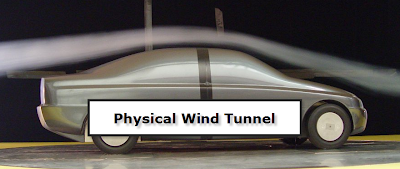
“For example,” he says, “wind tunnel or tank testing often is not all that expensive [when] compared to setting up and running CFD analysis. It is often easier to make the design iterations by playing around with a handful of clay and turn the wind tunnel back on, than it is to change the computer model and rerun the CFD analysis. But structural analysis of a large building design has to be done virtually. Physical analysis is economically impossible.”


It is interesting how many people share the same sentiment. The fact is there are only few instances where this may be the case. I was talking to an engineer at a very well-known valve manufacturer about this and he shared a few numbers with me.

He was designing a brand new line of poppet valves. He was responsible to ensure the pressure drop was within a certain range, as well as determining the spring needed to maintain stable flow over a wide range of flow rates. His ultimate goal was to have three prototypes (3 different sizes) ready to be outsourced for final physical testing. I asked how much were the outsourcing costs? $8k for three...whoa! Seemed steep to me, but I am all about virtual reality, I suppose.

So, let's say you didn't perform an Upfront simulation of the model and your three original designs were not up to snuff. So, you had to re-do the prototype testing. You have just justified the $$ for an Upfront CFD tool. But this is really just the tip of the iceberg. In reality if you had the simulation tool in place you could confidently pay for one round of validation testing at the end of the design cycle. But, more importantly, the simulation models would allow for innovative design that is not possible in the physical testing world. You aren't able to get in there and peel things away to see inside where the action is happening in a wind tunnel. You are limited on the data available and you induce inaccuracies with the measuring devices.

So, back to the article at hand. I think I understand where the guy was coming from. In the past, CFD was the big gorilla in the room. Everyone was afraid to go near it. It was too "expensive". Things have changed drastically over the years. More and more everyday. Whether its a wind tunnel, a flow bench or a thermal chamber or even a thermal camera, there are significant investments of time and materials required.

My friendly advice is to fire up Google and do a search for Upfront CFD.